News Archive
News and Events 2015
Antipodean Antiquities: Classics 'Down Under.'
This new volume to be edited by Marguerite Johnson and published by Bloomsbury aims to produce a collection of articles on the use of the Classical Tradition in Australian and New Zealand literature and screen. Papers should be around 6-8,000 words. Current contributors to the project are Ika Willis, Liz Hale, Anna Jackson and Geoff Mile. Please contact one of the project members or the editor for more information.
Dr Ika Willis: School of the Arts, English and Media; University of Wollongong ikaw@uow.edu.au
A/Prof Anna Jackson: School of English, Film, Theatre and Media Studies; Victoria University of Wellington Anna.Jackson@vuw.ac.nz
Dr Geoff Miles: School of English, Film, Theatre and Media Studies; Victoria University of Wellington
Geoff.Miles@vuw.ac.nz
Dr Liz Hale: School of Arts, University of New England ehale@une.edu.au
A/Prof Marguerite Johnson: School of Humanities and Social Science, The University of Newcastle
marguerite.johnson@newcastle.edu.au
News and Events 2014
Details about the major NZ receptions conference 'Athens to Aotearoa: Greece and Rome in New Zealand Literature and Society' at the Victoria University of Wellington on 4-6 September 2014 have been posted in the Conferences section of the website. The conference keynote speaker will be Prof. Witi Ihimaera (author of The Whale Rider). Further details will be posted as they become available.
News and Events 2013
‘History meets fiction in Doctor Who, The Fires of Pompeii’
Blog Post
Back in spring 2008 the new Doctor Who was entering its fourth season. David Tennant was the Doctor, Catherine Tate was his companion Donna, and Pompeii was the destination of their first journey through time together. Their arrival was not a great help to the majority of the town’s inhabitants, who met their pre-destined end on ‘Volcano Day’. However, for me, teaching a new course on ‘Living in Ancient Rome’, it was extremely fortunate. Our final class would examine representations of the Roman world today. That episode, ‘The Fires of Pompeii’, would make an excellent case study. Little did I realize as I sat down to watch that it would come to dominate my research for the next year and open my eyes to a whole new area of investigation: ancient history on television.
For more of this posting see: http://blog.journals.cambridge.org/2013/11/history-meets-fiction-in-doctor-who-the-fires-of-pompeii/
Practitioners' Voices in Classical Reception Studies
Open University
New Publication
The latest issue of the online journal 'Practitioners' Voices in Classical Reception Studies' has just been published. You can access content via the following link: http://www.open.ac.uk/arts/research/pvcrs/2013
Might is Right? Ancient and Modern Debates (InsideArts)
Foyles, 6 Quakers Friars, Cabot Circus, 1pm.
Sunday 10th November 2013
“We’re an empire now, and when we act, we create our own reality.” So claimed an aide of George W. Bush in 2004, but it’s an idea that dates back to 5th century BC Greece and the historian Thucydides – one of the most-quoted ancient writers in debates about contemporary affairs, including on such topics as the invasion of Iraq and post-9/11 US foreign policy. This public event, part of the annual InsideArts and Thinking Futures festivals of ideas, draws on the work of the Bristol Thucydides project over the last four years. There will be a staging of an adaptation of the Melian Dialogue, the famous passage in Thucydides' work where he explores different approaches to justice and interest in inter-state relations, by members of StudioSpace, the student drama society; this will be followed by a discussion between scholars working on different aspects of the topic and plenty of opportunity for questions from the audience.
Attendance is free, but we do ask you to reserve a place in advance: go to http://www.bristol.ac.uk/arts/festival/programme/2013/1.html. If you have any queries, please contact Neville Morley (n.d.g.morley@bris.ac.uk).
The Most Politic Historiographer: Thucydides in Modern Western Culture
Clifton Hill House, Bristol
Monday 25th-Tuesday 26th November 2013
Thucydides has been, at least since the nineteenth century, one of the most-cited and most influential classical thinkers. His work has inspired not only ancient historians and classicists, but historians of all periods, political theorists, international relations specialists, soldiers and military educators, and novelists, all of whom have found it a source of deep insight into the nature and experience of war and of how one should study this. This is the final research colloquium of the AHRC-funded project on Thucydides: reception, reinterpretation and influence, drawing together different themes in his modern reception with papers from a range of international experts and from members of the project team.
Attendance is free, but numbers are strictly limited, and places must be reserved in advance. If you have any queries, please contact Neville Morley (n.d.g.morley@bris.ac.uk) by 15th November.
Three
Ancient Sparta Comic Series
Colleagues with interests in classical receptions in modern popular culture may be interested to learn of the publication on October 9th of the first issue of a five-part monthly comics series set in ancient Sparta.
Titled Three, it’s a fictional story centred on three fugitive helots set in the 360s BC. The author is the well-known UK comics author, Kieron Gillen, supported by the equally renowned comics artist Ryan Kelly and colourist Jordie Bellaire.
The title purposely evokes the mythologised Sparta of Frank Miller’s and Zack Snyder’s 300; but Gillen’s aim was to counter-balance that over-glorified image through a more authentic depiction of Sparta in its period of crisis, incorporating in particular its exploitation of the helots. What may make Three especiallyinteresting to classicists is his consultation throughout the production process of colleagues in Nottingham’s Department of Classics and Centre for Spartan and Peloponnesian Studies.
Balancing historical authenticity and the demands of the ‘action comic’ genre has been one of the challenging but fascinating aspects of the collaboration, on which we hope to reflect in future oral and written forums.
Three is published by Image Comics and issues are available digitally via their website: https://www.imagecomics.com/comics/releases/three-1. Hard copies can be ordered from local comics stores, such as (in the UK) http://www.page45.com/store/Three-1.html#SID=1443 A collected graphic novel edition is expected in Spring 2014.
Theorising Reception Studies Downunder
University of Newcastle
20-21 February, 2014
Call for Papers
Classical Reception is an exciting and increasingly vocal element of Classical Studies today. While much research has been done on the interconnections between antiquity and modernity in terms of the United States, Europe and Britain, there has not been a thematic focus on the interchanges between the ancient worlds and Australia and New Zealand.
This two-day think-tank seeks to unpack the role of Reception Studies and its place within Australia and New Zealand from multiple perspectives.
See here for more details.
Enquiries: Marguerite Johnson (Marguerite.Johnson@newcastle.edu.au)
Ancient Dance in Modern Dancers
Colloquium
We are pleased to announce that the collaborative research network Ancient Dance in Modern Dancers (ADMD) is holding a colloquium to report the initial findings of the ADMD project, intended to generate discussion about methodologies for studying performance history across different disciplines.
The colloquium will be held on Tuesday 1st October, 11am - 5:30pm at the Classics Faculty, University of Oxford.
Speakers include Armand D'Angour (Oxford), Ruth Webb (Lille), and Stacey Prickett (Roehampton) as well as members of the ADMD network. There will also be live performances by project participants.
There is no formal registration, but please let us know if you plan to attend. For more information, please visit www.torch.ox.ac.uk/ancientdance or contact helen.slaney@st-hildas.ox.ac.uk.
The Study Of Humanism
CCANESA, University of Sydney
9 August, 2013
The morning will feature papers by Chris Celenza, Nicole Hochner, Miguel Vatter, and Mario Casari which will be devoted to discussing future directions in the study of humanism. The papers are designed to be short, punchy, risk-taking statements of future directions of research. The idea is to be more op-ed than academic. We want to capture that type of thinking that academic articles and monographs are bad at capturing. The afternoon will be devoted to reading selections from Machiavelli’s Discourses (text and translation attached).
For the program see here.
Classics and Modern/Contemporary Art
Blog Series
A new blog about Classics and Modern/Contemporary Art includes a series of posts about the role of Classical themes in the exhibition Riotous Baroque: from Cattelan to Zurbarán - Tributes to Precarious Reality curated by Bice Curiger and open at the Guggenheim.
The blog author would be very interested to hear from anyone who knows of any discussions of Classics and the Baroque - both in terms of Art History but also in other fields, such as Literature, Philosophy, History, Music, Architecture - that could give my 'dispatches' from the exhibition more context.
Website: http://minusplato.blogspot.com
Nemi at Nottingham
New Blog
A new blog has been launched as part of an AHRC-funded project to promote public engagement with 'hidden' collections by digital means and it complements a forthcoming exhibition at Nottingham Castle's Museum of their material from the Sanctuary of Diana at Roman Nemi. There is a strong Classical reception angle to the blog, which will cover the Victorian excavation and how the material came to be in Nottingham, Nemi's role as inspiration to nineteenth century authors (e.g. James Frazer etc.), as well as aiming to engage readers today, from both inside and outside the academy, with ancient artefacts and what they can reveal to the modern world.
Website: http://nemitonottingham.wordpress.com/
Maths, Politics, and Concrete: The Legacy of the Classical World
New Exhibition
University of Otago de beer Gallery
University of Otago, is pleased to announce the beginning of ‘Maths, Politics and Concrete. The Legacy of the Classical World’, an exhibition that aims to highlight some of the influences that the ancient Greeks and Romans have had on western civilisation. The exhibition starts on 28 June and runs through to 20 September 2013, and is open 8:30 – 5:00 Monday to Friday.
Classicist Richard Hingley once wrote: ‘The Classical past retains a highly significant relationship to the present’. It is certainly true that no cultural tradition develops in a vacuum, and that we are all influenced by those who have gone before us. From Homer’s Odyssey and the nascent secular intellectualism of the early Greek philosophers, to the recipe for concrete and the perfection of archway construction, the Classical World has left a legacy which we now take for granted. Indeed, the cultural legacy from Greece and Roman is all-encompassing in areas such as mathematics, medicine, law, and politics, to literature, philosophy, architecture and engineering.
This exhibition feature works by Ovid, Apollonius, Archimedes, Xenophon and Marcus Aurelius, names not necessarily familiar to all but ones which have definitely shaped the past. Notable items on display include a 1618 edition of Palladio’s Antiquitates Almae Urbis Romae; a leaf from the great Polyglot Bible of 1514-17; Oliver Byrne’s The First Six Books of the Elements of Euclid (1847); Isaac Asimov’s poem ‘The Foundation of Science Fiction Success’; and a facsimile of Abraham Lincoln’s Gettysburg Address.
For further details please contact: Romilly Smith, Special Collections Assistant, and curator of this exhibition, (Romilly.Smith@otago.ac.nz) or Dr. Donald Kerr, Special Collections Librarian (Donald.kerr@otago.ac.nz).
Reception of Ancient Greek Tragedy
New Website
A new website has been launched on the reception of ancient Greek tragedy.
As part of a research project, coordinated by Dr. Vayos Liapis and funded by the Research Promotion Foundation of Cyprus, the website aims at cataloguing and analysing the various ways in which ancient Greek tragedy and tragic myth have been adapted, reinterpreted, revised or re-imagined in Modern Greek poetry and theatre from the late 19th century to the present day.
Among other things, the website contains a fully searchable database of modern Greek poems and plays which set out to adapt, update, parody, or otherwise rewrite classical Greek drama. At present, users have access to entries on the poetry of George Seferis and Yiannis Ritsos, as well as to audiovisual material.
For further information please visit the website at: http://eumenides.ouc.ac.cy/
Classical Receptions Journal
Latest Issue Now Available.
Please log in to view the full list of articles here.
The Reception of Classical Literature
New Publication
This new Supplement to Brill’s New Pauly gives an overview of the reception and influence of ancient literary works on the literature, art and music from antiquity to the present. Ordered by the names of around 90 authors, detailed and clearly structured encyclopaedic articles discuss the post-classical reception history and interpretation by historical period of the most important works from ancient Greece and Rome. Each article is accompanied by a comprehensive bibliography for further study. This volume will be a welcome addition to scholarship not only for classical and modern literary studies, but also for many other disciplines.
Website: http://www.brill.com/reception-classical-literature
Greece and India
New Blog
Classicists may be interested in the following blog, which relates to our AHRC-funded collaborative project comparing Greek with Indian thought in the 'Axial Age'. Richard Fynes (De Montfort University) Richard Seaford (University of Exeter)
Website: http://atmanandpsyche.exeter.ac.uk/
Classics and Class
New Website
A fantastic new website has been launched with PDF articles from prominent Reception scholars involved (Edith Hall, Christopher Stray, Lorna Hardwick) in the Classics and Class research project.
Website: http://www.classicsandclass.info/groundwork/
New Teaching Resource - Socrates on Trial video
A video from the UBC performance of "Socrates on Trial" has recently been made available at UBC Circle: https://circle.ubc.ca/handle/2429/39408
Ovid's Myth of Pygmalion on Screen: In Pursuit of the Perfect Woman
Paperback by Paula James
March 2013
‘Drawing on an impressive range of scholarship, James... explores the ongoing fascination with Ovid’s Pygmalion story, explains why it still has powerful resonances today and, furthermore, suggests how its new reworkings can illuminate readings of Ovid’s Metamorphoses itself.’ Bryn Mawr Classical Review
Why has the myth of Pygmalion and his ivory statue proved so inspirational for writers, artists, philosophers, scientists, and directors and creators of films and television series? The 'authorised' version of the story appears in the epic poem of transformations, Metamorphoses, by the first-century CE Latin poet Ovid; in which the bard Orpheus narrates the legend of the sculptor king of Cyprus whose beautiful carved woman was brought to life by the goddess Venus.
Focusing on screen storylines with a Pygmalion subtext, from silent cinema to Buffy the Vampire Slayer and Lars and the Real Girl, this book looks at why and how the made-over or manufactured woman has survived through the centuries and what we can learn about this problematic model of 'perfection' from the perspective of the past and the present. Given the myriad representations of Ovid's myth, can we really make a modern text a tool of interpretation for an ancient poem? This book answers with a resounding 'yes' and explains why it is so important to give antiquity back its future.
Available for purchase here.
News and Events 2010
‘From Sappho to ... X’: Classics, performance, reception
August 20-22, 2010
A conference presented by the Centre for Drama and Theatre Studies and the Classical Studies Program of Monash University, in partnership with the Victorian College of the Arts and Music, the Australasian Classical Studies Reception Network, and Malthouse Theatre.
To coincide with Malthouse Theatre’s staging of the play Sappho...in 9 fragments, Monash University, the Victorian College of Arts and Music and the Australasian Classical Reception Studies Network are hosting a 3 day interdisciplinary conference on the relationship between performance and the Classics. The conference will bring together Classical scholarship, theatre studies, translation studies and cultural studies to investigate how performance manipulates and embodies our understanding of the classical world. Using the figure of Sappho as a metaphor for the many gaps we have to fill as we grapple with the otherness of the ancient world, the conference will explore how readers, translators, performers and spectators endlessly recreate the Classics in our imaginations and our embodiments.
Keynote Speakers:
Professor Andrew Benjamin (Monash University)
Professor Page Du Bois (University of California, San Diego)
Professor Simon Goldhill (University of Cambridge)
Professor Lorna Hardwick (Open University)
Professor Stanley Lombardo (University of Kansas)
Dr Margaret Reynolds (Queen Mary’s College, University of London)
Professor Peter Snow (Monash University)
A call for papers is located here.
News and Events 2009
International Numismatic Conference
July 16-18
The Oriental Society of Australia, University of Sydney, Australia, July 2009
The conference will comprise seven papers by international speakers on aspects of oriental coinage and economy from Japan to the Mediterranean. For further information, see Conference section of the website
Post-Doctoral Position 14/1/09
Brown University have advertised a two-year position in the field of Classical Reception Studies. Please check out the Jobs section of the website for further details.
Reception Colloquium at the University of Sydney
Classical Tradition and the Epic Impulse in Australian Theatre: The Lost Echo and The Women of Troy
A One-Day Colloquium, sponsored by The School of Arts and the Faculty of Arts & Sciences, University of New England.
Date: Monday, 2 February; 9 am to 5 pm.
Venue: Sancta Sophia College, University of Sydney
This colloquium will explore the recent collaborations in classical performance between Barrie Kosky, Tom Wright and the Sydney Theatre Company: The Lost Echo and The Women of Troy.
The Lost Echo was staged in 2006 at the Sydney Theatre Company: it provided a dazzling eight-hour adaptation of Ovid's Metamorphoses. The Women of Troy was staged in 2008 at the Wharf Theatre in Sydney and in Melbourne at the Malthouse Theatre. It provided an intimate staging of Euripides' text.
The colloquium will examine the significance, influence and dynamism of these two very different adaptations of classical texts.
Speakers from disciplines such as performance, literature, music, and classical studies will speak about The Lost Echo or The Women of Troy.
Tom Wright, the writer and translator of both productions, will give the keynote address.
For further details, see http://www.une.edu.au/arts/events/epic-impulse.php
News and Events 2008
First Australasian Conference in Classical Reception
The first conference devoted to the topic of Classical Reception will be held at Monash University on 20-21 September. For further details, see 'Conferences & Calls for Papers'.
Exhibition: Of Deities or Mortals
William A. Sutton Gallery, Christchurch Art Gallery
16 November 2007 - 10 February, 2008
Titled after a line in John Keats' poem 'Ode on a Grecian Urn', Of Deities or Mortals takes eight objects from the University of Canterbury's James Logie Memorial Collection and invites eight contemporary New Zealand artisits to respond to the works.
Sara Hughes, Jamie Richardson, Neil Pardington, Reuben Paterson, Marian Maguire, Liyen Chong, Tony de Lautour and Francis Upritchard have each chosen a work from the Collection and their mixed media response will be displayed along with the original ancient treasures. This meeting of old and new will bring interesting and unexpected juxtapositions, and is anticipated to throw new light on objects from the ancient past. For further details, see the Christchurch Art Gallery website.
News and Events 2007
Performance: Sappho
14 November to 2 December
Stork Stage, Melbourne.
This is a one-person play about Sappho performed by Jane Montgomery Griffiths from Monash University at the Stork Hotel Theatre. Jane uses Sappho's poetry to weave together the stories of her reception with a contemporary love story - something of a research project into if (and how) reception can be staged. The season runs from 14th November to 2nd December, Wednesday to Saturday at 8 pm, and Sundays at 3 pm. For further details a flyer is available to download here. For reviews, see here.
Radio Lecture: What's so new about neo-Latin? (Lingua Franca, ABC Radio National)
Originally just a local language of ancient Rome, Latin became the language of the Roman Empire and then the classical language of Europe. But a knowledge of its later usage - as what is now called 'neo-Latin' - by the Renaissance humanists, is essential to a proper understanding of our own culture and history.
In this programme, Yasmin Haskell (Cassamarca Foundation Associate Professor in Latin Humanism at the University of Western Australia) discusses neo-Latin and its impact. An audio download of the lecture is available here.
Announcement: A CRSN workshop for research students
The CRSN will be holding a workshop for graduate students entitled 'Reception, Disciplinarity and Academic Careers'
on 7 November, 2007 at Birkbeck, University of London. For further details, see the Conferences & Calls for Papers section of this website.
Public Lecture: Mythology and Marketing in the Renaissance
Professor Philip Ford (University of Cambridge)
27 September 2007 at 5:30 pm
Refectory, Main Quad, The University of Sydney
Philip Ford specialises in French and neo-Latin literature, with special emphasis on the relationship between humanism and writing, particularly poetry. Publications include George Buchanan, Prince of Poets, a book on Ronsard's Hymnes (1997), and proceedings of eight conferences organised in Cambridge on the French Renaissance. His most recent book is Jean Dorat, Mythologicum, ou interprétation mythologique de l'Odyssée X-XII et de L'Hymne à Aphrodite (Geneva: Droz, 2000), and he is at present completing work on the reception of Homer in the Renaissance. He is first President of the International Association for Neo-Latin Studies and Vice-President of the Société Française d'Etude du Seizième Siècle.
Research Seminar: Ancient History and Nineteenth-Century Historiography
Monday 24 – 25 September
Main Seminar Room, Drummond and Smith College
University of New England
What decisive contributions did some 19th-century classical scholars make to our understanding of various Greek and Roman historians, and how have their views stood the test of time in the century and more since then? This is the nub of the question on which a number of Classicists, Ancient and Modern Historians from various universities in Australia will be reflecting during the Seminar.
This research seminar is being run as a strand within the Australian Historical Association conference, being held at the University of New England from Sunday 23 to Wednesday 26 September 2007.
Speakers include: Norman Etherington (UWA), Paul Brown (UNE), Max Schmitz (UNE), Neil Morpeth (Newcastle), Greg Horsley (UNE), Graeme Bourke (UNE), James McLaren (ACU), Douglas Kelly (ANU), Edwin Judge (Macquarie), Tom Stevenson (UQ), Geoff Adams (Monash), and Ron Ridley (Melbourne).
Further details and a registration form are available here.
Classics and Comics
Proposals are invited for an edited volume to be entitled Classics and Comics.
Edited by George Kovacs (University of Toronto) and C. W. Marshall (University of British Columbia)
Comics have been a major element of popular culture in North America, Europe, and Japan for over a century. So far there has been very little work integrating the medium into a larger understanding of Western artistic and literary culture. In Classics and Comics, we shall begin this work by presenting the first extended integration of comics with the foundations of western culture, in a collection of 12-18 chapters, each approximately 5000 words in length. Further details about the project and abstract submission are available here.
Research Seminar: Protesilaus at Gallipoli, Thursday 6, September.
Associate Professor Chris Mackie (University of Melbourne)
5 pm, The Kevin Lee Room, The University of Sydney.
This talk is focused on the Cape Helles area at the tip of the Gallipoli peninsula. This is where the British and the French forces were based in 1915 in their struggle with Turkish forces. It is an area with a rich military history in antiquity, and a place that has seen great activity in various periods since then. This talk will begin with a discussion of the French role at Gallipoli and their excavations at Eski Hissarlik, both in 1915 and in the years immediately after the war. As far as the ancient context is concerned the focus of attention will be on the city of Elaious, especially the hero shrine of Protesilaus. The argument will be put that the latent presence of the shrine helps to inform the tragic events that took place around it in April 1915.
Chris Mackie is Director of the Centre for Classics and Archaeology at the University of Melbourne. His earlier research was on the Roman poet Vergil, but since then he has focused on the epics of Homer, and Greek mythology with an interest in 'reception studies'. His main research interest at the moment is the Dardanelles region, ancient and modern, which is the subject of this talk.
Public Lecture: Classical fantasies and ancient sexual realities
Paul Barrett Lecture Theatre, The University of New England
August 30, 2007, 1 pm.
Two leading Australian historians of sexuality are visiting the University of New England to present their recent research findings on sexuality in the ancient world and its echoes down the ages.
Robert Aldrich, who is Professor of European History at the University of Sydney and the author or editor of several books on the history of homosexuality, will explore some of the ways in which the idea of "Greek love" has inspired homosexual fantasies over the last couple of centuries in a paper titled "Classical fantasies and the modern homosexual". Dr Alastair Blanshard, who also lectures at the University of Sydney, will complement Professor Aldrich's paper by presenting the latest findings about the practice and significance of gay sex in the ancient world. Dr Blanshard is the author of Hercules: An Heroic Life. His paper will be titled "What's new about Greek homosexuality?".
Public Lecture: Thursday 21 June, 6-8 pm
The homes of A.B.Triggs and J.R.B.Stewart in NSW and their interior designs influenced by their numismatic interests
by Dr Nicholas Hardwick, Honorary Associate, Department of Classics and Ancient History, University of Sydney
Arthur B.Triggs (1868-1936) had a house at Yass called Linton, which contained a collection of coins, paintings, lace, manuscripts and books. Professor James R.B.Stewart of the University of Sydney (1913-1962) lived at Mt Pleasant, Bathurst (now Abercrombie House). He was a scholar of numismatics and had a coin collection, and his home contained an extensive library of fine and rare books on coins. The lecture will discuss an aspect of the history of house design and interior furnishing with the particular focus on the design requirements of collectors and scholars of coins for housing their collections and libraries.
Further details are available here.
Update: Hear Dr. Nicholas Hardwick discuss the subject of his lecture on Radio National's By Design programme. A podcast is available here.
PhD Scholarship at ADFA/UNSW
Applications are called for a PhD scholarship on the topic "Christopher Brennan’s annotations to texts in his Greek library and their implications for his poetry". For full details, see the Jobs page.
Report: ‘Classics Hell’: Re-Presenting Antiquity in Mass Cultural Media
‘Classics Hell: Re-Presenting Antiquity in Mass Cultural Media’ took place at the University of Reading on Tuesday, April 17th 2007. The event brought together speakers from UK universities from Edinburgh to Exeter. Topics for discussion included the reception of Classics by mass audiences in cinema, radio, television drama, video games, children’s literature, wargaming, news media, self-published novels, and pornography. The keynote speech by broadcaster and author Bettany Hughes (on communicating antiquity to a mass television audience) was followed by a total of five panels (thirteen papers in total including the keynote speech), plus opening and closing comments from the organisers, Dunstan Lowe and Kim Shahabudin.
Read the full conference report
Studia Humaniora Tartuensia - Volume 8
The editors of the journal "Studia Humaniora Tartuensia" (SHT) would like to announce that the journal is accepting papers for the 8th volume (2007).
SHT is a refereed journal of the humanities, which focuses on classical studies, ancient history, Neo-Latin studies, Byzantine studies, classical tradition, history of scholarship and philosophy. It is published on-line
only and is freely available to everyone (open access) at http://www.ut.ee/klassik/sht/. We accept papers in English, German, French or Latin. All submissions are anonymously refereed. Altogether seven volumes
(2000-2005) of the journal have been published.
Submissions to vol. 8 (2007) should be sent preferably by e-mail to the address sht.editors@gmail.com. Please check the above-mentioned web page for general submission guidelines. This year's volume has two major sections: A) classical studies and ancient history, and B) Neo-Latin studies. We would especially encourage you to submit to the latter
Research Seminars in Ancient History and Classics
Department of Classics and Ancient History
The University of Sydney
Next Seminar: Thursday 8 March
4-6 pm in the Kevin Lee Room
Nicholas Hardwick (4-5 pm):
An Etruscan vase from Leake's collection in the portrait of 'William Martin Leake' (painted 1838), National Portrait Gallery, London.
This seminar introduces the article by Nicholas Hardwick ‘Antiquities in British Nineteenth Century Paintings: Some New Discoveries’, The World of Antiques and Art, Issue 72 (February 2007-August 2007), pp. 110-2, which features the discussion of the vase in the portrait of Leake.
Classical Fantasies: The Use and Abuse of Same-Sex Love in Antiquity
A Panel Discussion
Sunday 25 February
Nicholson Museum, The University of Sydney
In the inspiring setting of the Nicholson Museum, a panel of six experts on sexuality will discuss issues arising from the modern use and perception of ancient same-sex love. The participants, many of whom have written extensively on the subject, include Professor Robert Aldrich, Dr Alastair Blanshard, Professor Stephen Garton, Dr Gail Hawkes, Assoc Professor Vrasidas Karalis, Dr Suzanne McAlister and Professor Elspeth Probyn. Proceedings will be highly entertaining and will include a champagne cream tea.
Time: 2.00pm-5.00pm
Cost: $25, $20 for members of the Friends of the Nicholson Museum and New Mardi Gras Members
Bookings essential: phone: (02) 9351 2812 or email m.turner@usyd.edu.au
This event is held in conjunction with the 2007 Mardi Gras Festival.
News and Events 2006
Report: 'Close Relations' Conference
A cross-disciplinary conference called Close Relations; the Spaces of Greek and Roman Theatre was held at the University of Melbourne, September 19-23, 2006. Both the University of Melbourne (Theatre Studies and Classical Studies) and Monash University (Classical Studies) hosted the conference, with financial support from the University of Melbourne, the Classical Association of Victoria, and the Australasian Society of Classical Studies. The convenors for the conference were Paul Monaghan, Jane Montgomery-Griffiths and Frank Sear.
The conference aimed to bring together scholars from diverse fields (Classical Studies including Reception Studies, Theatre Studies, LIterary Studies, History, Archaeology ... ) as well as theatre practitioners, to examine the phenomenon of Greek and Roman theatre from the perspective of 'space' (physical, performance, cultural, textual, memory and so on). We were blessed by the quality of our International keynote speakers, Professors Lorna Hardwick and Richard Beacham, and Dr. Dmitry Trubotchkin, who opened up these interrelated fields in so many interesting ways. During the conference delegates were able to consider our focus through conventional papers, performances and a competition at a local pub for the most inspiring expression of what Greek tragedy meant to us in 2006 (won by James McCaughey). Overall the conference was felt by many delegates to have been a huge success in terms of the range of diverse but complementary perspectives, but perhaps most importantly in terms of the respect for each other's approaches across what are sometimes such oppositional disciplines. Abstracts and program can be viewed on the conference website: http://www.cca.unimelb.edu.au/close/. Enquiries can be directed to me at pmonag@unimelb.edu.au
A collection of papers from the conference will appear as a focused issue of Didaskalia, and we are also negotiating a book deal with an established publisher.
Paul Monaghan
Theatre Studies
University of Melbourne
American Philological Association Annual Meeting, San Diego 4-7 January, 2007
This year's APA conference (San Diego 4-7 January, 2007) features more reception panels than ever before. For a guide to what's available in classical reception scholarship at the conference, check out the link under Conferences.
Lectures on Pre-Raphaelite Paintings and Ancient Jewish Coins
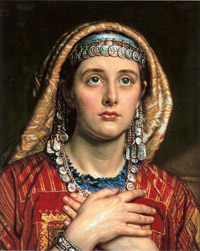 Dr Nicholas Hardwick, Honorary Associate, Department of Classics and Ancient History, University of Sydney, gave two lectures in September entitled ‘Ancient Jewish coins in William Holman Hunt’s works: a consideration of the artistic and the historical approaches of the artist’, at the Barrack Gallery, Art Equity, 16-20 Barrack Street, Sydney. Dr Nicholas Hardwick, Honorary Associate, Department of Classics and Ancient History, University of Sydney, gave two lectures in September entitled ‘Ancient Jewish coins in William Holman Hunt’s works: a consideration of the artistic and the historical approaches of the artist’, at the Barrack Gallery, Art Equity, 16-20 Barrack Street, Sydney.
The lectures revealed fascinating detective work about two works by the leading Pre-Raphaelite artist William Holman Hunt, produced while working on The Triumph of the Innocents, The Bride of Bethlehem (1879-1884) (formerly in the collection of John Schaeffer and exhibited in the Art Gallery of NSW) and Nijimi, a Bethlehemite woman, study for 'The Triumph of the Innocents' (1877), in the Walker Art Gallery, Liverpool, which show the intriguing use of ancient Jewish coins as women’s jewellery. One of the coins was the silver shekel from the 1st Jewish Revolt (AD 66-70), associated with the siege of Masada. The lectures considered the artistic and the historical approaches of the artist in the representations of Jewish coins in these works.
Dr Hardwick was interviewed about the discovery by Julie Copeland on ABC National ‘Exhibit A’ on 15 October 2006.
Picture: William Holman Hunt, 'The Bride of Bethlehem'.
Private Collection, courtesy of Nevill Keating Pictures.
Report: Humanism and Medicine
From 20-22 September, 2006, an international symposium on 'Humanism and Medicine in the Early Modern Era' was held at the University of Western Australia (supported by the ARC Network for Early European Research, the Cassamarca Foundation, and the Institute of Advanced Studies, UWA).
The proposal was to explore the complex, and sometimes troubled, relationship between humanism and medicine from the fourteenth through eighteenth centuries. The father of humanism, Francesco Petrarca, famously attacked the medical profession in his invectives 'Against a Certain Doctor' (1352). Humanism spoke a new language - theoretically a natural, classical Latin, as opposed to the 'barbaric' scholastic idiom of the philosophers and physicians. But the Renaissance also saw the rise of the so-called 'humanist doctor', and newly recovered classical texts were assimilated into the canon of learned medicine. Papers at our conference ranged over learned and non-learned traditions, from the perspectives of intellectual, social, and literary history. Click here for the full program.
A volume arising from the conference will be published as a special issue of Intellectual History Review (Routledge).
Yasmin Haskell
School of Humanities, University of Western Australia
ACRSN Website Launch
The ACRSN website was officially launched by Professor Lorna Hardwick at the 'Close Relations' conference on Friday, 22 September at the University of Melbourne.
|

